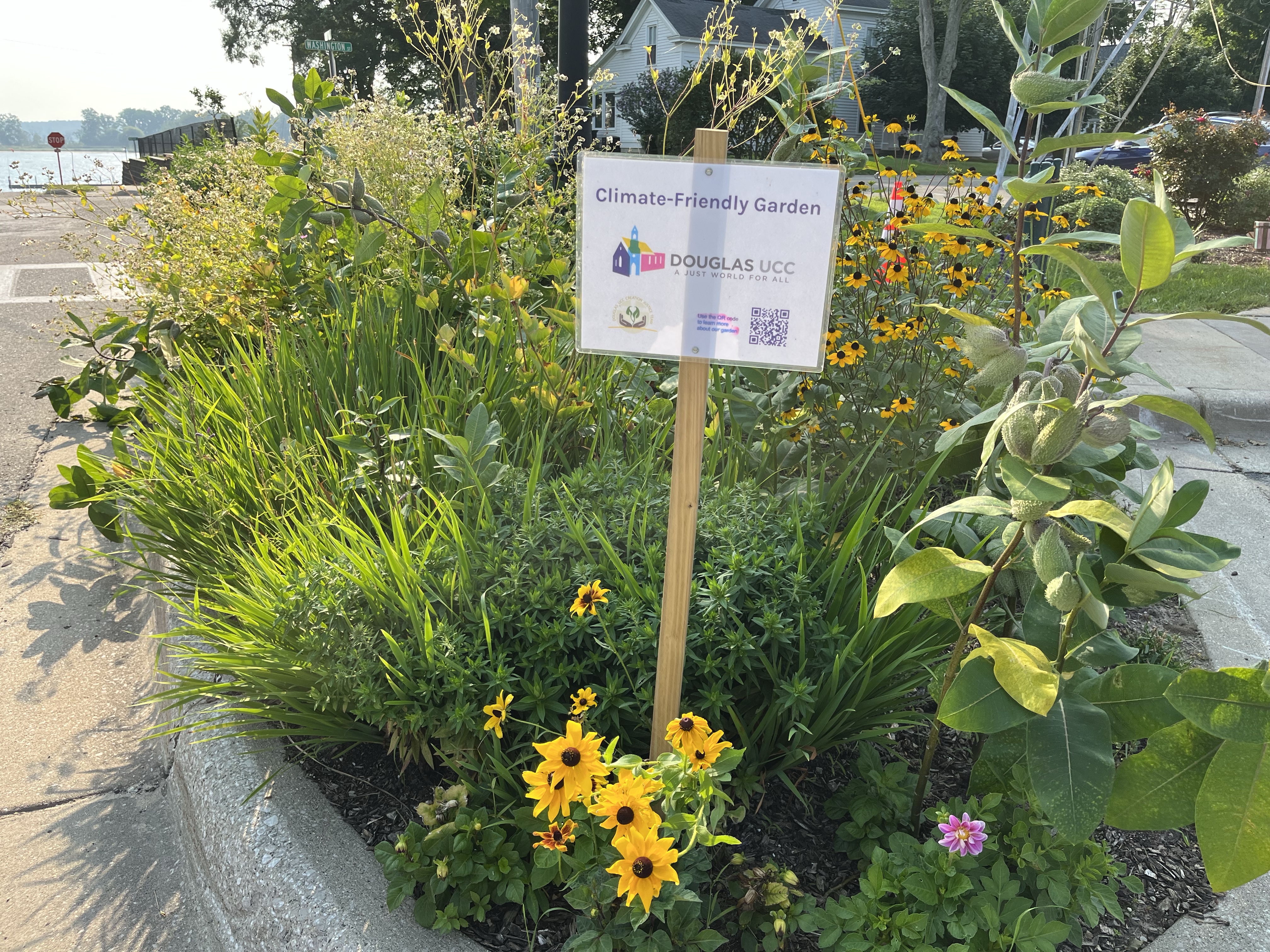
Genesis 2:16 tells us that when Adam was placed in Eden, God said it was his job to take care of the garden. Think about it: perhaps the answer to the existential “Why am I here?” is “To care for the Earth.” On a personal level, this notion can turn working on a garden into a religious experience!

In June 2023, the Creation Justice Team began hosting a small (200 sq.ft.) public garden at the corner of Center & Washington in Douglas. It’s a climate-friendly space with plants that we hope will attract pollinators. We inherited one non-native plant from the previous gardener and decided to leave it alone this year.
Caring for your own garden is one way to care for our planet. Weeding and watering are important, but we can do so much more in the era of climate change!
A brochure from the Union of Concerned Scientists, “The Climate-Friendly Gardener: A Guide to Combating Global Warming from the Ground Up,” encourages practices that include:
- Minimize Carbon-Emitting Inputs – use hand tools (vs. powered) and natural pest controls.
- Expand Recycling to the Garden – turn leaves, grass clippings, dead plants, and food waste into compost See this from the EPA.
Birds, Bees, and Native Plants
Over 180,000 different plant species rely on bees, birds, bats, butterflies, and other pollinators. More than 1200 crops – representing one out of every three bites of food we eat – could not be harvested without pollinators. They are a key element of a healthy ecosystem. Sadly, many pollinator populations are in a decline that is largely attributed to loss of habitat. Pollution, disease, misuse of chemicals, and climate change all contribute to the problem.
Planting local native plants in your garden will attract local pollinators and expand their habitat. See this from the USDA and this from the State of Michigan.
Less Grass, More Trees
Everything outside of your home – including the lawn- is part of the “garden.” All lawns require mowing and some are fertilized. Unfortunately, gas mowers and synthetic fertilizers contribute to the climate crisis. Reduce your lawn’s impact by making it smaller, mowing less frequently, mulching the clippings, and nixing the chemicals.
One way to shrink a lawn is to replace grass with trees and large shrubs. They take more carbon dioxide out of the atmosphere than grass and other plants. Trees also offer summer shade and protection from winter winds, reducing the need for heating and air conditioning.
Shagbark hickory, silver maple, and black walnut are examples of drought-resistant trees, and many other species are native to Michigan. If you’re planting more than one tree, plant a variety; diversity is good for the planet! See this from Michigan State.
More Information
- Lake Effect Garden and Design is a Saugatuck-based business that can help you create a native garden or native meadow on your property
- Native Plant Finder – enter your zip code for a list (National Wildlife Federation)
- Native Garden Design – a booklet by the Wild Ones organization
- Nature’s Best Hope – book by Douglas Tallamy
 Creation Justice @ Douglas UCC